


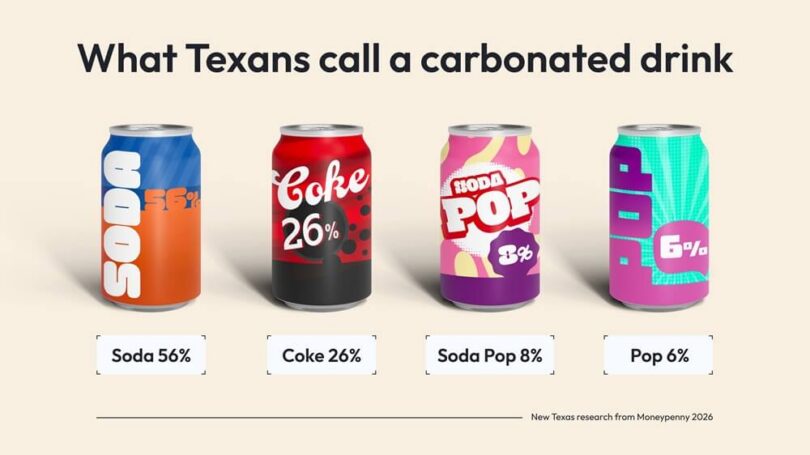

For generations, the stereotype has been that Texans call every soft drink “Coke.” New research suggests that may be changing, and the shift offers some interesting clues for brands trying to connect with today’s Texas consumer. If someone in Texas asks for a Coke, does that mean Coca Cola? Apparently, not necessarily. For years, the idea that Texans call virtually every carbonated drink a “Coke” has been one of those beloved regional quirks that marketers could count on. A Sprite could be a Coke. A Dr Pepper could be a Coke. A root beer? Also a Coke.
But according to new research from Moneypenny, that Texas tradition may be losing some of its fizz. A survey of 1,001 Texas residents conducted by Censuswide in August 2026 found that 56% of Texans now call a carbonated drink “soda,” while 26% use “Coke” as a generic term. Another 8% say “soda pop” and 6% simply say “pop.” For marketers, however, the more interesting story isn’t really about what Texans call their soft drinks. It is about how quickly the Texas consumer is changing.
The Texas marketing landscape is not one size fits all anymore
Texas has long been treated as a distinct market, and for good reason. But even within the state, language and cultural habits vary considerably. Remeber the scene from the movie Bernie when the old guy at the diner counter describes the “states” of Texas? It’s worth a watch.
San Antonio has the highest percentage of residents calling a carbonated drink “soda,” at 64%, followed by Houston at 59%. Dallas Fort Worth comes in at 53%, while El Paso is at 50%.
Age also makes a difference. Among Texans ages 18 to 24, 72% say “soda.” That drops to 59% among those 25 to 34 and 52% among those 45 to 54. Meanwhile, the generic use of “Coke” skews older. Thirty four percent of Texans ages 55 to 64 use “Coke” as a catch all for soft drinks, compared with just 16% of those ages 25 to 34. In other words, the classic Texas “Coke” may be less about geography than it is about generation. And that is something marketers understand well.
Y’all is still having a moment (Thank God)
If “Coke” is losing ground, “y’all” is doing just fine. In fact, the research found that 59% of Texans use “y’all” when addressing a group, compared with 16% who say “you guys.” (Chip and Joanna Gaines is a glaring example) Even more interesting: Gen Z is the generation most likely to use it. Seventy one percent of Texans ages 18 to 24 say “y’all,” compared with 64% of those ages 25 to 34 and 53% of those ages 35 to 44. For brands trying to sound authentically Texan, that is worth paying attention to.
Texas slang isn’t necessarily disappearing as younger consumers arrive. Some of it is being adopted by a new generation and becoming part of how younger Texans identify with the state.
Geography still matters, too. Austin leads the state in use of “y’all” at 69%, while Dallas Fort-Worth and Houston both come in at 57%. El Paso is a notable outlier at 38%.
Fixin’ to is still going strong
Some Texas expressions are apparently harder to shake. The most widely used phrase in the survey was “fixin’ to,” with 61% of Texans saying they use it. “Reckon” followed at 34%, then “over yonder” at 31%, “pitch a fit” at 30% and “might could” at 25%.
There is even a generational surprise hiding in the numbers. While most of these expressions skew older, “might could” is actually more popular among younger Texans. About one third of 18 to 24 year olds say they use it, compared with just 11% of those ages 45 to 54.
So much for the assumption that Texas language is simply fading away. It may be evolving instead.
For DFW marketers, the numbers get even more interesting
The research offers a particularly useful snapshot of the Dallas Fort-Worth market. Fifty-three percent of DFW respondents say “soda,” while 57% say “y’all.” Sixty-four percent say they use “fixin’ to,” and 16% speak Spanish fluently or fairly well. That last number is particularly important for marketers because Texas is becoming increasingly diverse, and language is one of the most obvious ways that change shows up. Statewide, 14% of respondents said they speak and understand Spanish fluently, while another 11% said they do so fairly well. In DFW, 16% reported speaking Spanish fluently or fairly well.
For brands operating in the Metroplex, the takeaway isn’t that every campaign suddenly needs to say “y’all” or include a Spanish version. It is that Texas consumers cannot necessarily be reduced to one Texas consumer. The language that feels natural to a 22 year old in Dallas may not be the same language that resonates with a 60-year old in Fort-Worth. And what works in DFW may not work in El Paso, San Antonio or Houston.
Authenticity is more complicated than a Texas accent
That distinction becomes even more interesting when the research looks at how Texans want businesses to sound. Moneypenny asked whether Texans would want an AI chatbot to reflect a local regional accent.The answer was mostly no. Forty-one percent said they would not want an AI chatbot to have a regional accent, while 29% said they would.
That may be one of the more useful findings for marketers. There is a difference between sounding local and trying too hard to sound local. A brand doesn’t necessarily become more authentic because it adds a “y’all,” a cowboy hat or an exaggerated Texas drawl to its messaging. Sometimes authenticity means understanding your audience well enough to know when not to do that.
So, Coke or soda?
For DFW, the answer is increasingly soda. But the bigger answer for marketers may be: it depends. It depends on age. Geography. Culture. Language. And increasingly, the many different communities that make up the Texas market. Texas may still be Texas. But the people living here, and the way they talk, are changing. And for brands trying to connect with them, that might be the most important thing to understand.